
Diastasis recti exercises are progressive core movements that retrain your deep abdominal muscles to manage pressure again after pregnancy. The goal is not to force a gap shut. The goal is a core that transfers load well, so your midline stops bulging.
Most people notice real change within eight to twelve weeks of consistent practice. What matters is how you breathe, how you brace, and how gradually you add load.
Here is what to do this week:
- Practice diaphragmatic breathing for three minutes a day, exhaling before every effort.
- Run a simple self check above, at, and below the navel to learn your starting point.
- Swap crunches, front planks, and double leg lowers for heel slides and bridges.
- Watch your midline during every rep and stop any movement that makes it cone outward.
- Walk ten to fifteen minutes daily to restore rhythm through your ribs and hips.
What Are Diastasis Recti Exercises And How Do They Work?
Diastasis recti exercises restore coordination between your diaphragm, deep abdominals, and pelvic floor. That coordination lets the midline hold pressure instead of leaking it forward.
They teach the transverse abdominis to fire before load arrives. That tension travels across the linea alba and stops the bulge.
Think of the linea alba as the seam running down the center of your abdomen. Pregnancy stretches that seam, and the two halves of the rectus abdominis drift apart.
The seam does not tear. It thins, softens, and loses the stiffness it needs to transmit force.
According to the StatPearls reference library hosted by the National Center for Biotechnology Information, most experts consider a separation greater than two centimeters outside the typical range. The same reference is clear that symptoms matter more than the measurement alone.
That single point reframes the whole conversation. Your job is not to chase a number.
Your job is to restore tension across the seam. The tissue then behaves like a working structure again.
We see this every week in the clinic. Two people arrive with the same finger width gap, and only one of them feels strong.
The difference is almost always control. One core knows how to generate tension on demand, and the other does not yet.
That is why our approach to diastasis recti recovery support starts with breathing and pressure management. Strength stacked on a leaky pressure system just moves the problem somewhere else.

How Do You Check For Diastasis Recti At Home?
Lie on your back with knees bent, place two fingers just above your navel, and lift your head slowly. If your fingers sink into a soft gap between two firm ridges, you are feeling the separation.
Check three spots, not one. Test above the navel, right at the navel, and about two inches below it.
Note two things at each spot. How many fingers fit side by side, and how much springy resistance you feel at the bottom.
- Width tells you how far apart the muscle bellies sit.
- Depth and tension tell you how well the connective tissue holds pressure.
- Doming or coning tells you the pressure is escaping forward.
- A soft, sinking feeling with no bounce means the seam needs more loading input.
Tension beats width every single time. A two finger gap with firm springy tissue functions better than a shallow gap that feels like pudding.
Run the check once a month, not once a day. Tissue changes slowly, and daily measuring only adds anxiety.
Not sure whether what you feel counts as coning or just a normal contraction? We look at this with clients every day in Durham and the Research Triangle. A trained set of eyes usually clears it up in one session, so call us at 919-342-7949 or book a visit with our team to walk through your self check together.
Which Diastasis Recti Exercises Are Safe To Start With?
Start with breathing, deep core activation, heel slides, bridges, and bird dog. These five build tension across the midline without heavy shortening load, which is what an early core needs.
Every movement below follows one rule. Exhale into the effort, and keep your midline flat.
Diaphragmatic Breathing With A Long Exhale
Lie on your back with one hand on your ribs and one on your belly. Inhale wide into the sides of your ribcage, then exhale slowly for six counts.
Feel the natural lift through your pelvic floor at the end of the exhale. That lift is the foundation of everything else.
Do three minutes daily. This is the highest value thing you can practice in the first two weeks.
Transverse Abdominis Activation
Place your fingertips just inside your hip bones. Exhale and gently draw the area under your fingers toward your spine, as if zipping snug jeans.
You should feel a low, quiet tightening rather than a hard clench. Flared ribs or an arched back mean the wrong muscles took over.
Hold for five seconds, release fully, and repeat ten times. Full release matters as much as the contraction.
Heel Slides
Lie on your back with knees bent and feet flat. Exhale, engage the deep core, then slide one heel away until the leg is nearly straight.
Inhale as the heel returns. Watch your midline the entire time.
Stop short of wherever the doming starts. That point is your current range, and it moves further out every week.
Glute Bridges
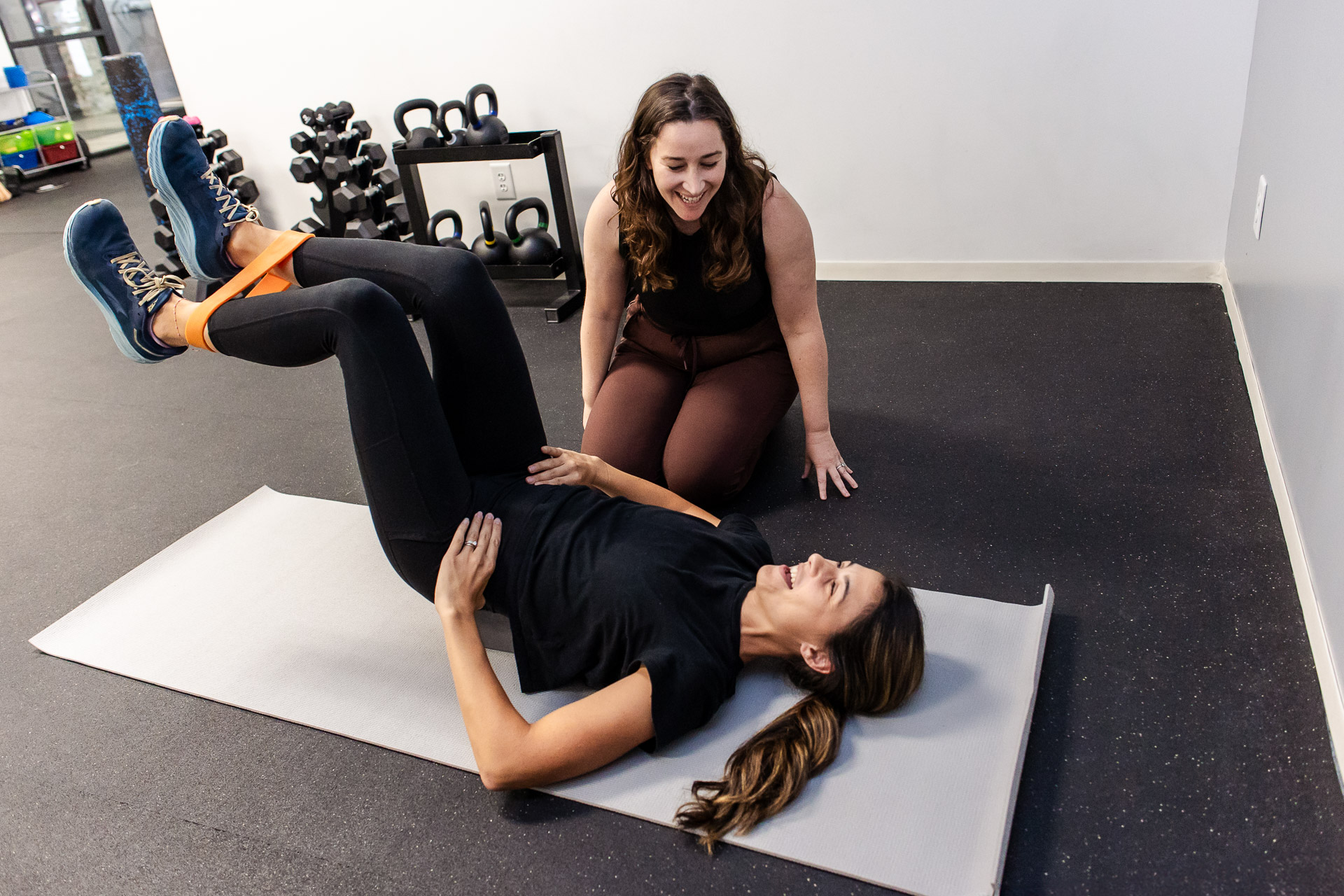
Exhale, engage, then press through your heels. Lift your hips into a straight line from knee to shoulder, and lower slowly on the inhale.
Your glutes carry a surprising amount of the core load. Weak hips force the abdominals to compensate, and that compensation shows up as a bulge.
Build to two sets of twelve before adding a weight across your hips.
Bird Dog
On hands and knees, exhale and extend one arm forward while the opposite leg reaches back. Keep your ribs down and your pelvis level.
Move slowly enough that a glass of water on your low back would stay put. Speed hides the compensations we want to eliminate.
Alternate for eight reps per side.
Side Lying And Standing Work
Add side lying clams, standing marches, and half kneeling presses once the floor work feels easy. Upright loading is where real life happens.
Carrying a car seat, lifting a toddler, and pushing a stroller all happen on your feet. Your core needs to hold tension there too.
What Exercises Should You Avoid With Diastasis Recti?
Avoid full sit ups, crunches, front planks, double leg lowers, and heavy twisting for now. These movements spike downward pressure faster than an early core can absorb it.
Nothing on this list is permanently off limits. Every one of them comes back once the seam earns it.
The NHS guidance on your body after pregnancy recommends avoiding sit ups, planks, and high impact exercise at first. It also flags straining on the toilet and heavy lifting as things worth managing during recovery.
| Skip For Now | Choose Instead | Why The Swap Works |
|---|---|---|
| Full sit ups and crunches | Heel slides with a long exhale | Keeps the abdominal wall long while the deep core learns to hold tension |
| Front planks on your toes | Incline planks with hands on a counter | Cuts the load through the midline while training the same pattern |
| Double leg lowers | Single leg marches | Halves the lever arm so your low back stays neutral |
| Russian twists | Half kneeling band chops | Trains rotation control without loading a flexed, twisted spine |
| Breath holding under heavy load | The same lift with an exhale on effort | Vents pressure upward instead of driving it into the seam |
| Deep backbends and boat pose | Bird dog with ribs stacked over the pelvis | Protects the linea alba from end range stretch |
Watch for three warning signs during any movement. A ridge along your midline, a bulge at the navel, or heaviness in your pelvic floor.
Any of those means the load exceeded your capacity. Regress the movement, exhale earlier, and try again.
How Long Does It Take For Diastasis Recti Exercises To Work?
Most people notice less doming within two to four weeks and clear strength change between eight and twelve weeks. Full return to running and heavy lifting usually lands between four and six months.
Your timeline depends on tissue quality, birth history, sleep, and how often you practice. Consistency beats intensity here by a wide margin.
| Phase | Typical Window | What You Practice | What Changes |
|---|---|---|---|
| Foundation | Weeks 0 to 6 | Breathing, deep core activation, walking | Less coning, better awareness, calmer pressure |
| Rebuild | Weeks 6 to 12 | Heel slides, bridges, bird dog, side lying work | Firmer tension at the midline, easier lifting at home |
| Load | Months 3 to 6 | Carries, split squats, incline push ups, rows | Strength returns, back and hip aches settle |
| Performance | Month 6 and beyond | Running, jumping, heavier lifting, sport | Confidence under impact and full load |
The NHS notes that the separation usually returns toward normal by the time your baby is eight weeks old. It also recommends connecting with a professional if an obvious gap remains past that point.
Plenty of people fall outside that window and still do beautifully. Do not read a slower timeline as failure.
Twins, a larger baby, a cesarean birth, or a second and third pregnancy all shift the curve. Your starting point is simply your starting point.
Can You Fix Diastasis Recti Years After Pregnancy?
Yes. Connective tissue responds to loading at any age, and we regularly work with clients whose youngest child is already in school.
The early postpartum window is convenient, not magical. Hormones make tissue more pliable in those first months, which speeds things along.
After that, progress comes from steady mechanical input instead of hormonal help. It takes longer, and it still works.
A 2025 network meta analysis in Scientific Reports pooled 27 randomized controlled trials. It covered 1,340 postpartum women and 39 different approaches.
Core exercise combined with breathing techniques ranked highest in that analysis. The mean reduction in inter recti distance reached 26.25 millimeters.
That number confirms what we see clinically. Active, breath driven core work outperforms passive approaches.
The one caveat is that older separations arrive with layered compensations. Years of gripping the upper abdominals or holding the breath build habits that need unwinding first.
Do Diastasis Recti Exercises Help With Back Pain And Leaking?
Often, yes. The same pressure system that lets your midline bulge also leaves your low back unsupported. Retraining it tends to improve all three problems at once.
Your deep core works as a canister. The diaphragm sits on top, the pelvic floor forms the base, and the transverse abdominis wraps the sides.
When one wall stops responding, the others take the overflow. That is why leaking on a run and a bulging midline show up together so often.
The StatPearls reference notes that abdominal separation can contribute to stress urinary incontinence and back pain. That lines up with what walks through our door every week.
Clients rarely come in for the gap alone. Our pregnancy and postpartum wellness work looks at the whole canister together, because splitting it into separate problems slows everyone down.
How Do You Return To Running And Lifting After Diastasis Recti?
Return when you can hold midline tension under single leg load and impact, not when a calendar date arrives. Most people clear that bar between three and six months.
Test yourself before you test the pavement. Three checks tell you most of what you need to know.
- Thirty seconds of single leg standing per side with no pelvic drop or midline bulge.
- Twenty controlled single leg calf raises per side.
- One minute of jogging in place with no leaking, heaviness, or coning.
Clear all three and you are ready for short intervals. Fail one and you have found exactly what to work on next.
Build running back with walk and jog intervals rather than continuous miles. One minute of jogging inside four minutes of walking is a fine place to begin.
Lifting follows the same logic. Rebuild with tempo work and moderate load, exhale on every effort, and add weight only when the midline stays quiet.
The Triangle is full of active people who want the American Tobacco Trail back. Others want the Eno River trails or a regular class schedule.
Our core rebuilding plan for abdominal separation is built around getting you there. The point is progress without the setbacks.
Frequently Asked Questions
Can Diastasis Recti Close On Its Own Without Exercise?
Some closing happens naturally in the first eight weeks after birth as hormones settle and swelling drops. After that window, spontaneous change slows down for most people. Progress then depends on how you load the core. Gentle daily practice gives the tissue a reason to adapt.
Is Walking Good For Diastasis Recti?
Walking is one of the best early additions to your routine. It restores rhythm through the ribs, hips, and core without spiking pressure. Start with ten to fifteen minutes on flat ground and keep your ribs stacked over your pelvis. If you feel heaviness in the pelvic floor afterward, shorten the walk and try again tomorrow.
Do Belly Binders Or Splints Fix Diastasis Recti?
A binder can feel supportive in the early weeks, and many people like the feedback it gives. It does not rebuild strength on its own, though, because your muscles still need to do the work. Use it as a short term comfort tool rather than a long term answer. Pair any binder with active breathing and deep core practice.
Can You Do Diastasis Recti Exercises While Pregnant?
Yes, and starting during pregnancy often makes the postpartum months easier. Breathing work, gentle deep core activation, and side lying strength stay appropriate well into the third trimester. Skip the movements that make your belly cone outward. Check with your provider before adding anything new during pregnancy.
Does Diastasis Recti Always Need Surgery If The Gap Stays Wide?
No. Width alone does not decide the outcome. Plenty of people with a wider gap build a core that feels stable and strong. Surgery becomes a conversation when a true hernia exists or when function stays limited after committed loading, and most people never reach that point.
How Many Days A Week Should You Do Diastasis Recti Exercises?
Aim for five to six short sessions a week rather than two long ones. Ten focused minutes daily beats an hour once a weekend, because connective tissue responds to repeated input. Keep one lighter day in the week for recovery. Quality of the contraction matters far more than session length.
Rebuilding Your Core With Real Support In Durham
A stronger midline is not about willpower or the perfect exercise list. It comes from the right load, in the right order, with someone watching how your body responds.
Why One On One Care Changes The Outcome
Every session with us is one on one with the same practitioner, start to finish. Nobody hands you a printout and walks away.
We watch your midline while you move and adjust the load in real time. We change the plan the moment your body asks us to.
Root Cause Instead Of Quick Fixes
We look at the whole system, not just your abdomen. Rib position, breathing pattern, hip strength, and daily habits all feed into how your midline behaves.
Closing a gap without addressing the pressure that created it simply invites the problem back. Root cause work holds up over years, not weeks.
Built Around Your Real Life
You have a baby, a job, and something you love doing outside. Your plan needs to fit all of it.
We build around ten minute sessions you can actually finish, then scale up as your capacity grows. Clients come to us from Durham, Raleigh, Chapel Hill, Cary, and RTP for exactly that.
Start Your Recovery This Week
Two options make a great starting point. Our Complimentary Root Cause Movement Assessment is a 30 minute one on one session that maps where your core stands today.
Our Postpartum StrongStart Bundle then guides you through a four week recovery and core rebuilding series. We design the whole thing around your findings.
Call us at 919-342-7949 or book a visit with our team to get started. Your core can absolutely feel strong again, and we would love to help you get there.

