Pelvic girdle pain pregnancy symptoms come from the joints of your pelvic ring, not your lower back. The pain sits at the pubic bone in front, at one or both sacroiliac joints behind, or both.
This pain shows up when the joints of your pelvis share load in a brand new way. It is common, it is real, and it responds well to changes in how you move.
You do not have to accept it as the price of being pregnant. Small changes to how you leave the car and roll in bed often shift your whole day.
Here is what matters most, right up front.
- Pelvic girdle pain sits at the pubic bone or the sacroiliac dimples, while lumbar pain sits higher.
- Loading one leg at a time is the giveaway, so stairs and car exits often sting.
- Keep your knees together for transfers and turn as one unit.
- Strength work at the hip and deep core usually helps more than resting.
- Most pelvic girdle pain settles in the months after birth, and support speeds that along.
What Is Pelvic Girdle Pain In Pregnancy?
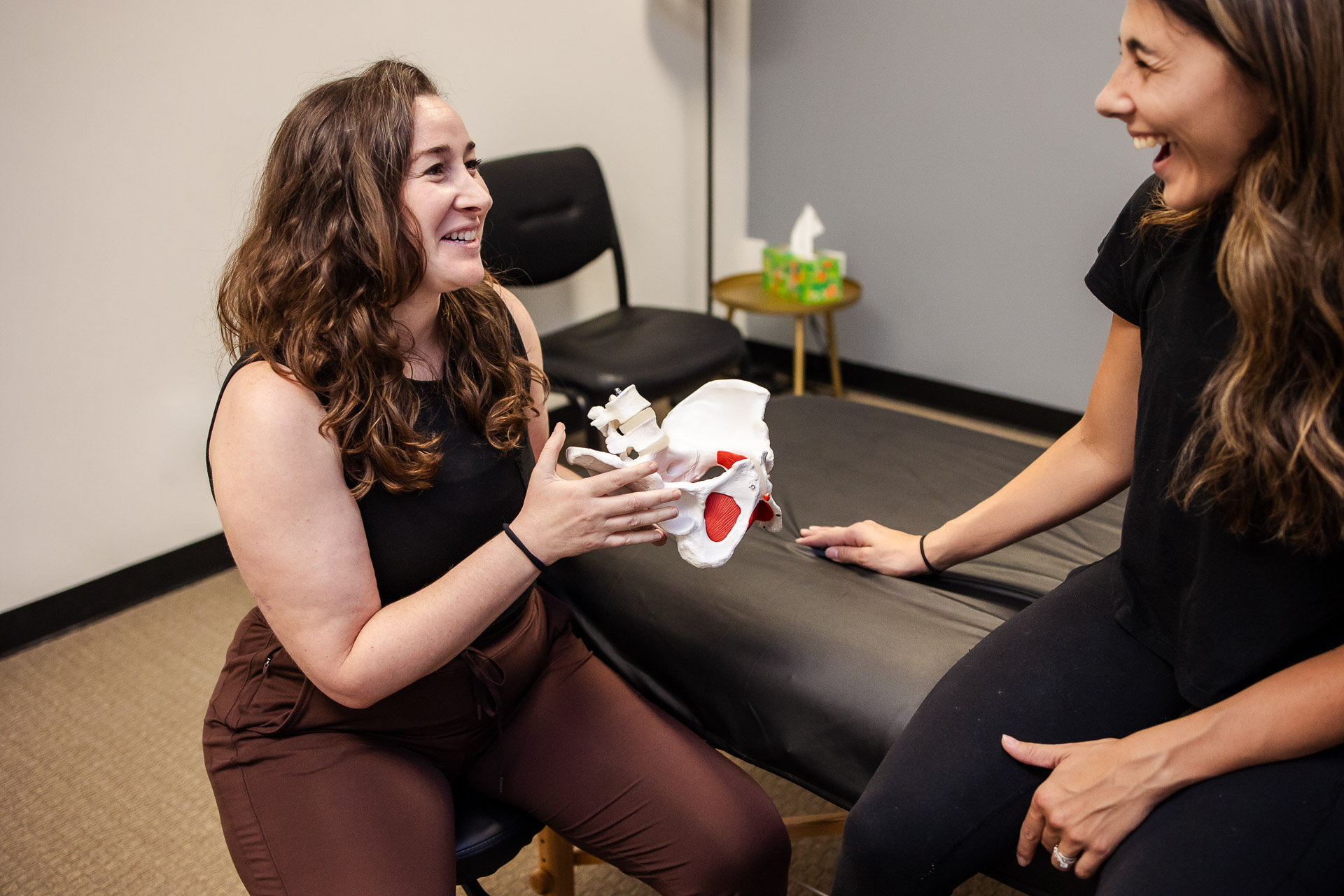
Pelvic girdle pain is joint pain in the ring that holds your pelvis together. Pregnancy changes how those joints share load, and pain can land anywhere on the ring.
The Pubic Symphysis At The Front
The pubic symphysis is the small cartilage joint at the front of your pelvis. It normally moves only a few millimetres, and pregnancy softens the ligaments holding it steady.
When this joint gets sore, you feel a sharp catch low and central. Rolling in bed, opening your legs to dress, and standing on one foot are classic triggers.
Some people also notice a clicking or grinding feeling with certain steps. That sound is unsettling, but on its own it does not signal damage.
The Sacroiliac Joints At The Back
The sacroiliac joints sit at the back of the ring, one on each side. You can usually find them at the two small dimples above your buttocks.
Pain here often feels deep, dull, and one-sided. It can spread into the buttock or the back of the thigh, and rarely past the knee.
Many people describe it as a bruise that will not go away. Long sitting, then standing up, tends to make it announce itself.
How Common Is Pelvic Girdle Pain?
It is far more common than most people expect. The National Health Service reports that pelvic girdle pain affects up to 1 in 5 pregnant women to some degree.
A 2021 evidence review from the National Institute for Health and Care Excellence agrees. It notes that 1 in 5 women experience pain in the pelvic girdle region during pregnancy.
Ready to stop guessing? Call us at 919-342-7949 or book a time to talk. Our pregnancy and postpartum wellness care happens one-on-one, in a private room, across Durham and the Triangle.

How Do You Tell Pelvic Girdle Pain From Lumbar Back Pain?
Location is the fastest clue. Pelvic girdle pain sits at the pubic bone or the sacroiliac dimples. Lumbar back pain sits higher, above your waistband.
The two flare with different movements and call for different support plans. Plenty of people have both at once, which is why sorting them out matters.
| What You Notice | Pelvic Girdle Pain | Lumbar Back Pain |
|---|---|---|
| Where it sits | Pubic bone, groin, sacroiliac dimples, buttock | Above the waistband, across the low back |
| Typical quality | Sharp catch or bruised ache, often one-sided | Broad, muscular, achy and stiff |
| Worst movements | Stairs, rolling in bed, standing on one leg, car exits | Long standing, bending forward, lifting a toddler |
| Walking distance | Shrinks fast, sometimes within a few blocks | Often improves once you warm up |
| Odd extras | Clicking or grinding in front, waddling gait | Muscle spasm, tightness after sitting |
| What tends to help | Symmetrical loading, knees together transfers, support belt | Gentle mobility, position changes, hip strength |
| Referral pattern | Groin, inner thigh, buttock, rarely past the knee | Low back into the upper buttock, sometimes down the leg |
If your pain sits higher and feels muscular, the lumbar spine is the better place to start. We wrote a companion piece on back pain during pregnancy and how pelvic floor physical therapy helps.
Why Does Pelvic Girdle Pain Happen During Pregnancy?
It happens because the load on your pelvis climbs while the joints holding it become more mobile. Neither change is a flaw, and together they simply ask more of your muscles.
Your Ligaments Soften While The Load Grows
Hormonal shifts increase the give in your pelvic ligaments. The joints stay safe, but they need more active muscular control to feel steady.
At the same time, your baby and uterus add weight in front. The system now has more to manage with less passive help.
Your Center Of Mass Moves Forward
As your bump grows, your ribs and pelvis stack differently. Your glutes and deep abdominals often go a little quiet in that new position.
Quiet muscles mean the joints absorb more of the shock. That is usually where the catching sensation begins.
Load Sharing And Timing Fall Out Of Sync
Pelvic girdle pain is rarely about one weak muscle. It is about timing between your deep core, your glutes and your pelvic floor.
When those groups fire slightly late, one side of the ring takes a bigger share. Retraining that timing is why targeted pelvic floor therapy changes symptoms so quickly.
What Changes Trimester By Trimester
Pelvic girdle pain pregnancy patterns shift as you move through the trimesters.
| Stage | What Usually Happens | What Helps Most |
|---|---|---|
| First trimester | Occasional twinges, often mistaken for a groin strain | Hip and glute strength, breathing coordination |
| Second trimester | Pain becomes predictable with stairs and single-leg tasks | Movement changes, symmetrical exercise, belt trial |
| Third trimester | Shorter walking tolerance, night pain, harder bed transfers | Sleep setup, transfer technique, birth positioning plan |
| First six weeks after birth | Symptoms usually fade as load and hormones settle | Graded walking, gentle core and hip work, real rest |
| Three to six months after birth | Most people feel close to normal, some need longer | Progressive strength, guided return to running or lifting |
What Does Pelvic Girdle Pain Feel Like Day To Day?
Most people describe a sharp catch at the pubic bone, or a deep ache over one sacroiliac joint. Between flares, you may feel completely fine, which is one reason the pain gets brushed off.
- A stab low and central when you swing one leg out of the car.
- Pain climbing stairs that eases when you take one step at a time.
- A grinding or clicking feeling in front with certain steps.
- Dread about rolling over in bed at two in the morning.
- Walking distance that shrinks week by week without a clear reason.
- A waddle that appears by evening after a long day standing.
None of that means something is broken. It means the ring wants better load sharing and a smarter daily setup.
Which Daily Movements Make Pelvic Girdle Pain Worse?
Any movement that loads one leg, or that separates your legs, tends to provoke pelvic girdle pain. That is why stairs, cars, beds and dressing dominate the list.
The fix is almost never to stop moving. The fix is to change the shape of the movement.
Getting In And Out Of The Car
Sit down onto the seat first with both feet still outside. Then swivel both knees together as one unit and bring your legs in.
Reverse the same order on the way out. A plastic bag on the seat helps you rotate without the fabric grabbing you.
Doing this once is easy. Doing it every single time is what calms the joint down.
Stairs
Lead with the same leg each time and bring the second foot up to meet it. Use the rail, and slow the whole thing down.
Stack your trips so you climb less often. Keep a spare charger and a water bottle upstairs.
Rolling Over In Bed
Keep your knees together and squeeze a pillow between them before you turn. Roll like a log so your shoulders and hips move together.
Satin or silky pyjama bottoms reduce friction against the sheets. It sounds small, and it works.
To get up, roll to your side, drop your legs off the edge and push through your arms. Avoid sitting straight up from flat.
Single Leg Loading Through The Day
Sit down to put on trousers, socks and shoes. Standing on one leg to dress is one of the most common daily triggers we see.
Stand with your weight even across both feet rather than parking on one hip. Keep your feet closer together when you stand a while.
Push a trolley rather than carrying a heavy basket on one side. Split heavy loads into two hands, or into two trips.
Sleep And Sitting Setup
Put a firm pillow between your knees and another under your bump when you side lie. Keeping the knees stacked stops the top hip dragging on the joint.
At a desk, sit fully back into the chair with both feet flat. Cross-legged sitting and long sofa slumps both tend to feed pelvic girdle pain.
Do Pregnancy Support Belts Help Pelvic Girdle Pain?
For many people, yes, a pelvic support belt gives real relief. The National Institute for Health and Care Excellence reviewed the evidence. It found that a non rigid lumbopelvic support belt produced a clinically meaningful reduction in pain.
Fit matters more than brand. A pelvic belt sits low, around the widest part of your hips, not up at your waist.
Snug is the goal, not crushing. You should still breathe easily and slide a finger under the strap.
How To Use A Belt Well
- Wear it for the parts of the day that provoke you, such as walking or shopping.
- Take it off when you sit for long stretches or when you sleep.
- Pair it with strength work rather than using it as your only strategy.
- Stop and reassess if it adds pressure to your pelvic floor or your bump.
A belt buys comfort while your control improves. Think of it as scaffolding, not as the building.
What Exercises Are Safe With Pelvic Girdle Pain In Pregnancy?
Symmetrical, well-controlled strength work is usually safe and helpful, and full rest tends to make things worse. The aim is to load both legs together and build hip, deep core and pelvic floor coordination.
Pain during an exercise is a signal to change its shape, not to quit moving. Most people keep training with sensible edits.
Start With Breathing And Coordination
Lie on your side or sit tall and breathe into your lower ribs. Let your pelvic floor lengthen as you inhale, then gently lift and exhale.
National Health Service guidance suggests 3 sets of 8 squeezes every day for the pelvic floor. Anchoring one set to each meal makes it stick.
Build Hip And Glute Strength
- Glute bridges with your feet hip-width apart and your knees together.
- Side-lying hip abduction with a small range and a slow tempo.
- Clamshells with your heels together and your pelvis steady.
- Wall sits or box squats to a comfortable depth with even weight.
- Hip hinges at a bench with a light load and both feet planted.
Keep your knees roughly hip-width. Wide stance work often provokes the pubic symphysis.
Keep Cardio Symmetrical
Swimming, stationary cycling, elliptical work and short flat walks usually feel best. Breaststroke leg kick is the classic exception, so switch to a flutter kick.
The talk test is a simple guide. The National Health Service notes that you should be able to hold a conversation while you exercise.
What To Modify Or Pause
- Deep lunges, split squats, and step-ups on a high box.
- Wide sumo squats and very wide yoga stances.
- Long single-leg balance work while your symptoms are hot.
- Running, if your walking tolerance is already dropping.
- Anything that leaves you sorer the next morning.
Pausing something is not losing it. We use these edits to keep you training through pregnancy.
How Do You Plan For Labor And Birth With Pelvic Girdle Pain?
You plan by knowing how far your legs comfortably separate, then sharing that range with your birth team. Positions that keep your legs closer together tend to feel much better.
Find your comfortable range on a calm day. Lie back, let your knees open slowly, and note where the pubic bone objects.
Positions Worth Trying
- Side lying with a peanut ball or pillow between your knees.
- Hands and knees, or leaning forward over a birth ball.
- Kneeling upright against the bed or a support person.
- Supported standing with your feet close together.
What To Put In Your Notes
Write your comfortable leg separation into your birth preferences. Ask your team to avoid holding your legs wide during position changes.
This matters most if you have an epidural. When sensation is reduced, you cannot feel the joint asking you to stop.
Does Pelvic Girdle Pain Go Away After Birth?
For most people, it improves quickly once load and hormone levels settle. A smaller group needs longer and needs a real plan rather than more waiting.
Early days after birth still involve plenty of single-leg work. Stairs, car seats, and carrying a baby on one hip all keep the ring busy.
What Recovery Support Usually Looks Like
- Keeping the knees together transfer habits for a few more weeks.
- Short, frequent walks that build gradually rather than one long outing.
- Gentle deep core and glute work restarted early and progressed slowly.
- A structured return to running, lifting, or court sport when symptoms are quiet.
If pain still limits you at six weeks, that is a good moment to get eyes on it. Ongoing pregnancy and postpartum care in that window shortens the whole story.
When Should You Contact Your Maternity Provider?
Most pelvic girdle pain is a movement and load problem, and it does not need urgent attention. A few signs sit outside that picture, and those deserve a same-day call.
- Regular tightening or cramping that comes in a rhythm before 37 weeks.
- Any vaginal bleeding, or a sudden gush or trickle of fluid.
- Fever, chills, or burning when you pass urine.
- A noticeable drop in your baby’s usual movement pattern.
- New numbness around the saddle area, or new bladder or bowel changes.
- Severe pain that starts suddenly and does not ease with position changes.
None of that is likely, and calling is never an overreaction. Your maternity team would far rather hear from you early.
Frequently Asked Questions
Is Pelvic Girdle Pain In Pregnancy Dangerous For My Baby?
No, pelvic girdle pain does not harm your baby. It affects the joints and muscles supporting your pelvis, not the uterus or the placenta. The main cost is to your comfort, your sleep, and your activity levels.
Can I Still Walk For Exercise With Pelvic Girdle Pain?
Usually yes, as long as you stay under the distance that flares you. Two short walks often feel far better than one long one, and flat routes beat hills. If your walking tolerance keeps shrinking, swap in swimming or cycling for a while.
Why Does My Pelvic Girdle Pain Feel Worse At Night?
Night pain usually comes from position and from load built up through the day. Side lying without support lets your top knee drop forward, which twists the pelvis. A firm pillow between your knees and a log roll technique fix most of it.
Will Pelvic Girdle Pain Come Back In My Next Pregnancy?
It can return, and starting stronger genuinely changes how the next pregnancy feels. Building hip, deep core, and pelvic floor strength beforehand gives your pelvis more active support. Many people who prepare this way report a much milder second experience.
Does Pelvic Girdle Pain Mean I Cannot Give Birth Vaginally?
Not at all. Most people with pelvic girdle pain have a vaginal birth without extra difficulty. It helps when the birth team knows your comfortable leg range.
How Long Does It Take To Feel Better Once I Start A Support Plan?
Many people notice a difference in the first one to two weeks. Movement changes and a well-fitted belt do most of that early work. Strength and coordination gains build over roughly six to eight weeks.

How We Support You Through Pelvic Girdle Pain
You deserve more than being told that pelvic pain is just part of pregnancy. We look at how your whole body shares load, then build a plan around your week.
One-on-One Care In A Private Room
Every session happens with one practitioner, in a private room, start to finish. Nothing about pelvic health should feel rushed or exposed.
You choose what happens at every step, and we explain the reasoning first. Consent is a conversation, not a form.
A Plan Built Around Root Causes
We look past the sore joint to the hip strength, breathing pattern, and daily habits feeding it. That is what makes relief hold.
Your plan fits the life you live in Durham, Raleigh, Chapel Hill, Cary, or RTP. If you still run, lift, or practice prenatal yoga, we build around that.
Support That Carries Into Postpartum
The pelvis that carried your pregnancy is the same pelvis that carries a car seat. We keep working with you back to full strength.
Talk To Us When You Are Ready
Call 919-342-7949 or reach out through our contact page and tell us what your pelvis is doing. We will listen properly.
Two easy ways to start with us:
- Complimentary Root Cause Movement Assessment, a 30-minute one-on-one session where we map what drives your pain.
- Pelvic Floor Confidence Program, a 6-session individualized pelvic health plan built for your body and your goals.
You can stay active, sleep better, and enjoy this pregnancy more than you do right now. Call 919-342-7949 and let us help you get there.

